
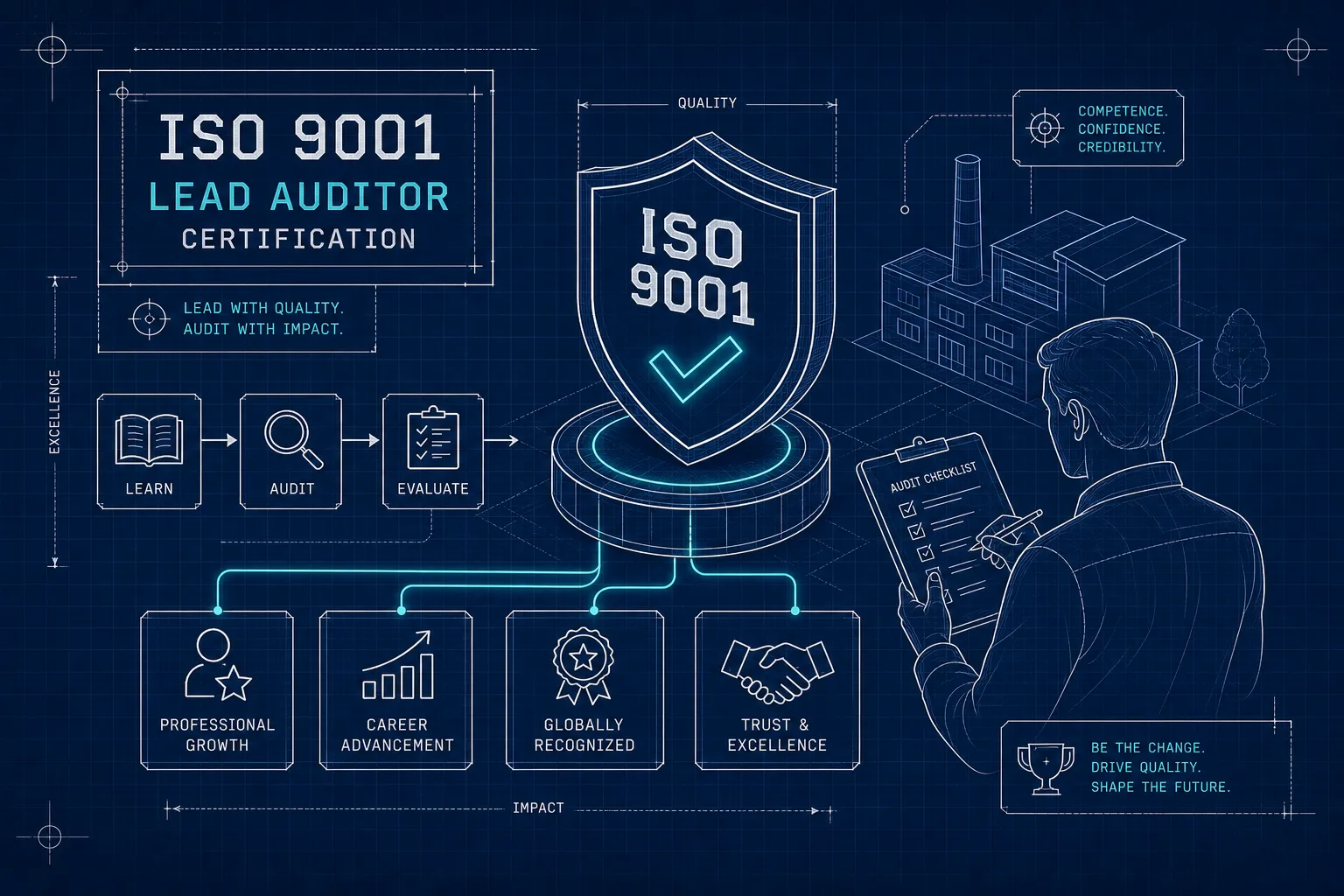
ISO 9001 Lead Auditor certification qualifies professionals to plan, lead, and manage Quality Management System (QMS) audits. Unlike an Internal Auditor, a Lead Auditor oversees the entire audit process, manages audit teams, evaluates evidence, and prepares audit reports used for certification decisions. However, not all lead auditor courses provide a globally recognized credential—some only issue a training certificate, while others lead to registration with recognized personnel certification bodies.
For maximum recognition, professionals should choose training aligned with CQI/IRCA or Exemplar Global, while ASQ and PECB also offer respected certification pathways. Most lead auditor courses last 5 days (about 40 hours) and cost between $900 and $3,500, depending on the delivery format. The credential can open opportunities in quality management, compliance, consulting, and third-party certification auditing.
Many professionals enroll in a "lead auditor course" and assume they walk away with a globally recognized credential. That's not always true, and the difference matters more than you might expect. Some programs issue a training certificate; others register you inside a personnel certification scheme that employers and accreditation systems actively look for. This guide breaks down exactly what ISO 9001 lead auditor certification is, which bodies issue credentials that carry real weight, and how to choose the right path for your goals in 2026.
In our experience at KSQA, small businesses working toward ISO 9001 certification increasingly want to understand the lead auditor role before they even begin their certification journey. Knowing what a lead auditor will look for changes how you prepare your documentation, your processes, and your team. That context is as useful for the business getting certified as it is for the professional pursuing the credential.
This article covers the lead auditor versus internal auditor distinction, which certification bodies actually matter for recognition, prerequisites, costs by format, exam structure, and what the ISO 9001 lead auditor certification does for your career in the United States.
Lead auditor vs. internal auditor: what's actually different
What a lead auditor is responsible for
A lead auditor has the authority to plan, conduct, and close a complete audit. That means managing an audit team, writing findings, sampling evidence across an entire quality management system, and producing audit recommendations that the certification body uses to determine whether that system conforms to the standard. This is categorically different from an internal auditor, who evaluates their own organization's processes as part of that organization's certification maintenance. The lead auditor credential is what certification body auditors carry, and it's what third-party audit roles require.
The CQI/IRCA grade framework makes this hierarchy concrete. A Provisional Auditor has completed training but has no audit experience yet. An Auditor conducts full-system audits independently. A Lead Auditor plans and manages audit teams through the full audit lifecycle. A Principal Auditor operates at a senior professional level, often overseeing audit programs or contributing to audit standards development. Each grade reflects both training completion and verified audit experience, not just course attendance.
Why this distinction matters when your business is pursuing certification
For companies preparing for ISO 9001 certification, understanding the lead auditor's methodology shapes how you build your documentation and your corrective action process. Lead auditors sample evidence systematically; they classify nonconformances as major or minor based on specific criteria; they evaluate the effectiveness of your processes, not just whether procedures exist on paper. When you understand that lens, you build your QMS to hold up under genuine scrutiny rather than just checking boxes.
This is the practical overlap between certification consulting and ISO 9001 lead auditor training: the more your team understands how a lead auditor thinks, the more focused and less stressful your audit preparation becomes. Whether you're a quality manager looking to earn the credential or a business owner building a QMS from scratch, both paths benefit from understanding this distinction clearly.
ISO 9001 lead auditor certification: which bodies matter for recognition
CQI/IRCA and Exemplar Global: the two global benchmarks
CQI/IRCA (the Chartered Quality Institute's International Register of Certificated Auditors) and Exemplar Global are the two most portable credentials internationally. CQI/IRCA issues auditor grades tied to approved training courses and verified audit experience. Exemplar Global uses a competency-unit model: QM for quality management systems knowledge, AU for auditing management systems, and TL for leading audit teams. Both operate as personnel certification schemes, which means they register individual auditors rather than simply issue training course completions.
We view this as the most important concept to understand before you enroll anywhere. A training certificate from a course says you attended and completed the program. Registration within a recognized scheme says your competence has been evaluated against a published standard by a credentialing body that employers and accreditation systems recognize. When a job posting says "IRCA-registered lead auditor required," a training certificate from an unaffiliated provider won't satisfy that requirement.
ASQ and PECB for U.S.-based professionals
ASQ's ISO 9001 lead auditor credential is well-recognized in the U.S. job market, and ASQ's course is Exemplar Global-certified, which gives it some international portability. PECB is a separate international certification body with a structured exam framework and a credential recognized globally, though it operates as a distinct pathway from IRCA or Exemplar Global rather than feeding into those same registries.
In practical U.S. job market terms, IRCA is the most commonly named credential in job postings, with Exemplar Global accepted alongside it. Employers frequently use language like "IRCA or equivalent" or "IRCA/Exemplar Global," treating them as broadly interchangeable. ASQ appears in postings more as a general quality credential than as a specific ISO 9001 lead auditor requirement. If your primary goal is U.S. employment, ASQ is credible and recognized; if you want maximum international portability, a program tied to CQI/IRCA or Exemplar Global is the more reliable choice.
Training providers versus personnel certification schemes
BSI, SGS, LRQA, Intertek, and similar firms are training providers, not certification schemes. Their lead auditor courses carry real value when they explicitly tie to CQI/IRCA or Exemplar Global. A five-day course that doesn't connect to a recognized scheme produces a training certificate, not a certified auditor credential. The course may be excellent, but without scheme alignment it doesn't get you registered in the framework employers look for.
Before enrolling anywhere, ask the provider one direct question: which personnel certification scheme does this course satisfy, and how does completion connect you to registration within that scheme? A strong answer names the scheme, explains how course completion feeds into registration, and tells you what audit experience you'll need to document afterward. If the provider can't answer that clearly, keep looking.
Prerequisites and the training path before you enroll
What you need before you start
Most programs expect you to arrive with prior knowledge of ISO 9001 requirements and a basic understanding of audit concepts. IRCA-pathway courses commonly recommend prior QMS or internal audit experience, and some require it. There's no single universally published minimum audit-hours figure across all bodies at the course entry level, but prior auditing experience accelerates your progression to lead auditor registration within any scheme.
Practically speaking, "prior ISO 9001 knowledge" means you've read the standard, ideally worked within a QMS environment, or completed an introductory ISO 9001 foundation course. Arriving at a five-day lead auditor course without that foundation puts you at a real disadvantage. The course assumes you're building on QMS knowledge, not learning it from scratch during the training itself.
Course formats and realistic time commitment
Five days and approximately 40 hours is the common standard for instructor-led ISO 9001:2015 lead auditor courses, whether delivered in a classroom or virtually. Blended options typically extend to around six days total, splitting pre-work eLearning across roughly two days with live classroom or virtual sessions making up the remaining time. Self-paced eLearning spans 16 to 40 hours of guided study, typically completed over one to four weeks depending on pace.
Classroom formats suit learners who benefit from structured peer discussion and real-time practice with audit scenarios. Online instructor-led courses offer the same interaction with geographic flexibility. Self-paced formats work best for professionals with irregular schedules who need to move at their own speed. All three formats produce equivalent results when the program ties to a recognized scheme; the delivery method is secondary to the scheme alignment.
ISO 9001 lead auditor certification, costs and prerequisites
Breaking down pricing by delivery format
Current market pricing across delivery formats breaks down as follows (ranges based on published provider pricing as of 2026):
- Classroom/in-person: $900 to $3,500
- Online instructor-led/virtual live: $600 to $2,500
- Blended: roughly $800 to $2,500
- Self-paced eLearning: $681 to $1,500
The price spread is driven by provider reputation, CQI/IRCA approval status, whether exam fees are bundled, and location. A premium-priced classroom course from a major provider is not automatically a better choice than a mid-range online option if both carry CQI/IRCA certification. The scheme alignment matters more than the sticker price. Spend your evaluation time confirming scheme affiliation, not comparing price tags at face value.
Costs people often overlook before enrolling
Exam fees are sometimes bundled into the course price and sometimes charged separately, so confirm this before you commit. Retake fees add up quickly if you don't pass on the first attempt. PECB, for example, offers one free retake within 12 months for partner-delivered training, but subsequent retakes carry fees and mandatory waiting periods of 15 days to 12 months depending on how many attempts you've made. If your course leads toward IRCA or Exemplar Global registration, expect ongoing CPD requirements and renewal costs as part of the long-term picture.
According to CQI/IRCA's published scheme requirements, their credentials carry a five-year validity period with 45 hours of structured CPD required over each three-year period to maintain registration. PECB credentials are valid for three years with annual maintenance fees required each year. Factor these into your total cost comparison from the start so you're comparing the full investment, not just the enrollment fee. Check the CQI/IRCA and PECB websites directly for current renewal requirements, as these can be updated.
Exam structure, pass criteria, and how to actually prepare
How the major exams work
PECB's ISO 9001 Lead Auditor exam is open-book, covering 12 questions across seven domains that include QMS fundamentals, ISO 9001 requirements, audit planning, conducting and closing audits, and audit program management. The passing score is 70%. Allowed materials include a hard copy of ISO 9001, your course notes, and a hard copy dictionary. Electronic devices are not permitted for paper-based exams. Confirm current exam format and allowed materials on PECB's official site before your exam date, as requirements can change.
CQI/IRCA's exam is also open-book, delivered online through their SARAS platform. The exam runs one hour and 45 minutes and covers 40 objective questions across five sections. Pass criteria require at least 50% overall and at least 40% in every individual section. That second requirement is the critical one: you can't compensate for a weak section by excelling in others. Every section has to clear its threshold independently. Review the current CQI/IRCA candidate handbook for the latest exam specifications before you sit.
Practical exam tips that hold up on test day
Open-book does not mean easy. Both exams test your ability to apply the standard to audit scenarios, not just recall clause numbers. Based on candidate feedback and practitioner experience, the sections that most often trip people up are audit planning (evidence sampling, scope definition) and nonconformity classification, specifically the criteria that distinguish a major nonconformance from a minor one.
Spend your preparation time on audit process scenarios rather than clause-by-clause reading. Work through sample scenarios that ask you to determine how you'd sample evidence for a given process, or how you'd classify a finding when a procedure exists but isn't being followed consistently. For the CQI/IRCA exam specifically, be deliberate about pacing: the section-specific pass threshold means spending too long on a difficult section can cost you passing marks in a section you know well.
U.S. career impact and what certified lead auditors actually earn
Job titles and roles that require this credential
The ISO 9001 lead auditor certification opens doors across a range of roles: QMS Lead Auditor, Quality Systems Auditor, Quality Manager, Compliance and Assurance Specialist, and third-party registrar auditor. Internal roles sit within a company's quality function; external roles include certification body auditors and independent quality consultants. For professionals moving from quality engineer or internal auditor positions into senior audit roles, the lead auditor credential is often the formal bridge that makes their resume competitive.
Employer job postings in 2026 consistently pair the certification requirement with hands-on QMS experience, industry-specific knowledge in manufacturing, healthcare, or aerospace, and demonstrated documentation and reporting skills. The certificate opens the door; the audit experience behind it keeps you in the room.
Salary ranges and what the data actually shows
U.S. salary data shows a clear progression by experience level: entry-level lead auditor roles typically fall between $58,000 and $72,000; mid-level roles range from $75,000 to $95,000; senior auditor roles land between $98,000 and $118,000; and director or principal-level positions reach $120,000 to $145,000 and above. ZipRecruiter's U.S. data reports an average of approximately $103,000, with most workers earning between $80,500 and $132,500. Independent consultants with strong credentials and industry-specific experience charge between $85 and $175 per hour.
The salary range is wide because the credential is one input among several. Industry sector, whether the role is internal versus third-party, geographic location, and depth of QMS experience all influence where within that range you'll land. The lead auditor credential for ISO 9001 establishes your baseline qualification; everything else around it determines your earning power.
Choosing the right program: the core decision framework
Start by identifying whether you need a course certificate or a recognized personnel credential. If you're pursuing career roles that specify IRCA or Exemplar Global registration, you need a program that ties directly to one of those schemes, a provider's reputation alone won't satisfy that requirement. Confirm scheme alignment before you enroll, budget for the full cost including exam fees, retakes, and renewal from day one, and be honest with yourself about your current ISO 9001 knowledge before signing up for a course that assumes you already have it.
For organizations building a QMS that needs to hold up under a certified lead auditor's scrutiny, understanding this landscape is equally valuable. At KSQA, we find that businesses tend to prepare more effectively when they understand the methodology their auditor will apply. That preparation shows up in better documentation, tighter corrective action records, and a smoother path to certification. Whether you're pursuing the lead auditor course online or in a classroom, or getting your organization ready for its third-party audit, knowing this landscape puts you in a stronger position from the start.
If you're ready to pursue ISO 9001 lead auditor certification, whether for your own career or to prepare your business for audit, reach out to KSQA directly. Most people just need a clear starting point and a reliable process, and that's exactly what KSQA provides.
Frequently Asked Questions (FAQs)
1. What is ISO 9001 Lead Auditor certification?
ISO 9001 Lead Auditor certification demonstrates that an individual has the knowledge and skills to plan, conduct, lead, and report on Quality Management System (QMS) audits based on ISO 9001 requirements.
2. What is the difference between a Lead Auditor and an Internal Auditor?
An Internal Auditor conducts audits within their own organization to support continual improvement. A Lead Auditor manages complete audit programs, leads audit teams, and performs third-party or supplier audits for certification or compliance purposes.
3. Who issues recognized ISO 9001 Lead Auditor certifications?
Well-recognized personnel certification bodies include:
- CQI/IRCA
- Exemplar Global
- PECB
- ASQ(through approved training pathways)
4. Does completing a lead auditor course automatically make me a certified Lead Auditor?
Not always. Some courses only provide a training completion certificate, while others are approved by recognized certification schemes that allow you to apply for professional auditor registration after meeting experience requirements.
5. What are the prerequisites for a Lead Auditor course?
Most providers recommend:
- A basic understanding of ISO 9001:2015
- Familiarity with Quality Management Systems (QMS)
- Some auditing or quality management experience (recommended, but requirements vary by provider)
6. How long does ISO 9001 Lead Auditor training take?
Most instructor-led programs run for 5 days (approximately 40 hours). Self-paced and blended learning options may take 1–4 weeks, depending on your schedule.
7. How much does ISO 9001 Lead Auditor certification cost?
Typical pricing includes:
- Self-paced online:$681–$1,500
- Virtual instructor-led:$600–$2,500
- Classroom training:$900–$3,500
Additional costs may include exam fees, certification registration, and renewal fees.
8. What is included in the Lead Auditor exam?
Exams generally assess:
- ISO 9001 requirements
- Audit planning and preparation
- Conducting audits
- Evidence collection
- Nonconformity classification
- Audit reporting
- Audit program management
Many recognized exams are open book, but they emphasize practical application rather than memorization.
9. What career opportunities does Lead Auditor certification provide?
The certification can support careers as:
- Lead Auditor
- Quality Manager
- Quality Systems Auditor
- Compliance Manager
- Supplier Auditor
- Third-party Certification Auditor
- ISO Consultant
10. Is ISO 9001 Lead Auditor certification worth it?
For professionals involved in quality management, supplier auditing, consulting, or certification audits, Lead Auditor certification is a valuable credential that enhances technical expertise, increases career opportunities, and strengthens credibility with employers and clients.



.jpg)