
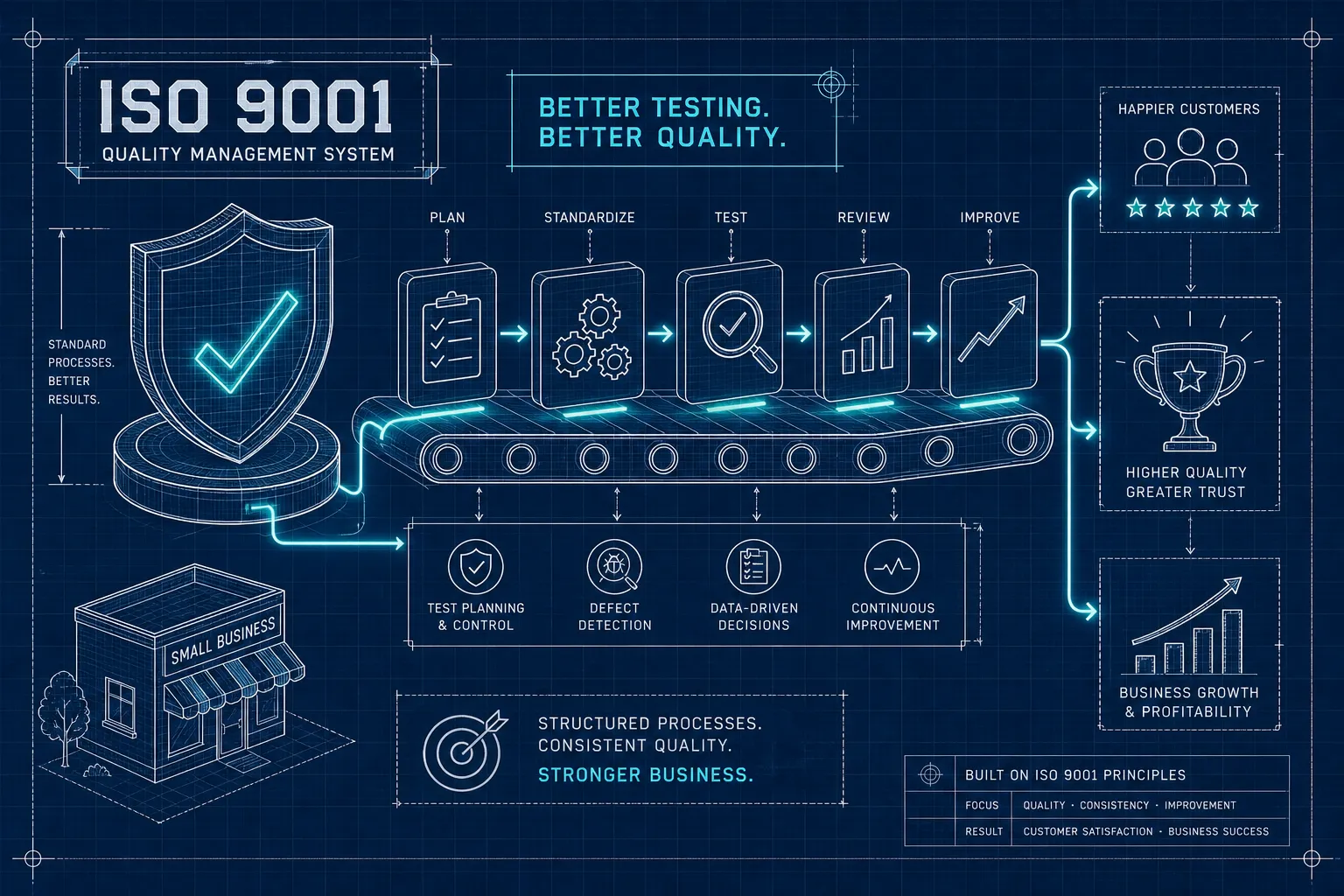
ISO 9001 improves quality testing processes by replacing inconsistent, informal practices with standardized, documented, and repeatable procedures. Instead of relying on individual experience or "the way we've always done it," the standard requires businesses to define testing methods, acceptance criteria, record results, and take corrective action when problems occur. This leads to more consistent product quality, fewer defects, reduced rework, and greater customer confidence.
For small businesses, ISO 9001 focuses on practical process control rather than excessive documentation. By implementing clear testing procedures, tracking key quality metrics, and using continual improvement through the PDCA (Plan-Do-Check-Act) cycle, organizations can build a reliable Quality Management System (QMS) that supports growth, improves operational efficiency, and prepares them for certification.
How does ISO 9001 improve quality testing processes in small businesses? Here's a practical answer. Picture this: your team ships a batch of products on Monday, tests them one way, ships another batch on Friday, and tests them a completely different way. Same product, same line, two different outcomes. A customer complaint lands in your inbox two weeks later, and you have no clear record of what happened or who signed off. Many small businesses run quality testing on instinct and institutional knowledge rather than a defined process. That gap, not the people, is what causes defects to slip through, rework costs to climb, and customer relationships to erode.
ISO 9001 is not a pile of bureaucracy designed for Fortune 500 companies. It's a framework that replaces informal testing habits with a controlled, repeatable process that any small team can run. The standard's requirements map directly onto the exact testing problems that hurt small businesses most: operator-to-operator variation, undocumented acceptance criteria, and corrective actions that never actually prevent recurrence. At KSQA, our Certification Road Map is designed to help small businesses work through these improvements step by step, with documentation and audit workflows scaled to a real team rather than a compliance department.
By the end of this article, you'll know which ISO 9001 clauses govern your testing process, what to document, which five metrics to track, and what realistic improvement looks like within the first few months.
Why informal quality testing quietly kills small business growth
The hidden costs of testing without a system
Inconsistent testing has a price, and it's higher than most small business owners realize. Defects that slip through final inspection become customer returns. Customer returns become negative reviews, lost contracts, and reputational damage that can take years to recover from. The deeper problem is that these failures are invisible until they're expensive: you don't see the rework hours accumulating, the material waste compounding, or the customer who quietly stopped reordering.
Consider a small manufacturer where Technician A tests a component in the morning using one set of acceptance criteria, and Technician B tests the same component in the afternoon using a slightly different standard because no written procedure exists. The product passes both times. Neither technician is wrong; they're just inconsistent. That inconsistency is where defects hide, and it's a process problem, not a people problem. Hiring or training alone is unlikely to solve variation without a defined standard and documented procedure behind it.
Why "we always do it this way" is not a quality process
Tribal knowledge feels reliable until the person who holds it walks out the door. Undocumented institutional knowledge creates three specific risks that hurt small businesses during growth: it disappears with employee turnover, it can't be audited or objectively improved, and it gives enterprise buyers and contract reviewers no confidence in your outputs. When a prime contractor or government agency reviews your supplier qualification, a good track record is not enough. They need evidence of a controlled process.
Small businesses that want to win larger contracts and qualify for new supply chains need to demonstrate that their testing results are reproducible regardless of who performs the work. That's exactly the kind of operational credibility that ISO 9001 quality testing processes in small businesses are designed to build. That's the foundational shift the standard enables.
How does ISO 9001 improve quality testing processes in small businesses, key clauses and SOPs
Clause 8: the core of what gets tested and how
Clause 8 (Operation) is where quality testing lives in ISO 9001. It requires you to define what must be tested, against what acceptance criteria, using what method, and how results are recorded. In practice, this means specifying the inputs that enter your testing step, the method used to evaluate them, the threshold that separates pass from fail, and the record that proves the evaluation happened. Documented evidence of conformity must be retained before product release, with an exception for release authorized in advance by a competent person or the customer per the relevant subclause. That single requirement eliminates the "we checked it but didn't write it down" problem that shows up constantly in surveillance audits at small manufacturers.
Clause 8 also covers incoming supplier controls, which feed directly into your testing process. If the materials entering your production line are inconsistent, your first-pass yield will reflect that whether or not your internal testing is perfect. A supplier whose dimensions vary batch to batch will generate nonconformances that no amount of internal rigor can fully absorb.
Clauses 9 and 10: measuring results and acting on failures
Clause 9 (Performance Evaluation) and Clause 10 (Improvement) form the feedback loop that makes testing progressively better over time. Clause 9 requires you to decide what to measure, how often, and what the measurements mean. Clause 10 requires that when a test fails or a nonconformance occurs, it triggers documented corrective action, not just a quick fix and a reset. This distinction matters enormously. Most small businesses stop at the fix; ISO 9001 requires you to go further and prevent recurrence.
Clause 7 covers the supporting elements that make test results reliable: calibrated equipment, competent personnel, and a controlled work environment. A failed calibration or an undertrained tester is a Clause 7 nonconformance, and it will surface in an audit.
How the process approach and PDCA cut defects and retests
Standardizing testing steps reduces operator-to-operator variation
The process approach treats testing as a controlled workflow with defined inputs, sequential steps, clear responsibilities, and a recorded output. When every tester follows the same sequence against the same criteria, results become repeatable. Repeatability is what reduces false passes, missed defects, and retests caused by contradictory outcomes between operators. Research into ISO 9001 implementation among small manufacturers consistently points to defect rate reductions in the range of 25% to 32%, with variation removed through standardized process execution identified as the primary driver. (For a precise figure from your own operation, establish your first-pass yield baseline at implementation and track it monthly.)
A practical controlled testing process for a small manufacturer looks like this: defined incoming inputs, step-by-step execution against written criteria, a review gate before release, and a test record tied to a specific unit or batch. That structure is not complicated. It's just explicit where before it was assumed.
Using PDCA to turn every test failure into a future prevention
The Plan-Do-Check-Act cycle is where small businesses tend to underperform. Most teams Plan the test and Do it, then Check the result, find a failure, fix the product, and move on. ISO 9001's Clause 10 requires the Act step: root cause analysis and a procedural update that addresses why the failure occurred, not just what failed. That distinction separates businesses that keep encountering the same defects from businesses that systematically reduce them over successive testing cycles. The improvement is cumulative and measurable within three to six months of consistent application.
Building your quality testing SOP without drowning in paperwork
The minimum documents a small business actually needs
ISO 9001 does not require a procedure for everything. The documented information principle is clear: document what you need to control, not everything you do. For a quality testing workflow, a practical minimum core includes a testing SOP, an inspection and test record, a nonconformance log, and a corrective action form. Some organizations also add internal audit records from the start, depending on scope. A well-written one- to two-page SOP covering actual test steps is more operationally useful than a 40-page quality manual that no one reads.
A simple testing SOP structure follows this sequence: purpose, scope, responsibilities, step-by-step method, acceptance criteria, and records. Each section should be written in plain language, specific enough that a new hire could execute the test correctly on day one without asking someone to demonstrate it.
How to build a nonconformance and CAPA workflow that gets used
A practical nonconformance process starts the moment a test fails. The record doesn't just note the failure; it captures what failed, what disposition was made (rework, scrap, or hold), and what investigation followed. A corrective action record closes the loop: root cause identified, corrective step taken, verification that the fix worked and the problem didn't recur. The entire process can live in a simple spreadsheet or shared folder at the start. The goal is a system your team will actually use consistently, not one that exists in a binder for the audit and nowhere else.
Shallow root cause analysis is one of the most common corrective action failures found in surveillance audits at small manufacturers. The product gets fixed but the procedure doesn't change, and two months later the same defect reappears. Build the habit of asking "why did this happen?" before asking "what do we do with this unit?" and your CAPA system will be genuinely effective.
The 5 KPIs that show your quality testing is improving
Setting up your testing measurement baseline
Improvement can't be tracked without a starting point. At the beginning of ISO 9001 implementation, pull whatever historical data exists on defect rates, rework incidents, and customer complaints. Many small businesses don't have clean historical data yet, and that's fine. Starting a fresh log from implementation day forward still gives you a meaningful before-and-after comparison within three to six months, enough data to bring into your first management review with real substance.
The five metrics worth tracking from day one
A focused KPI dashboard for a small business testing program should cover five measures:
- First-pass yield: the percentage of items that pass testing the first time without rework. Calculate it as units passing on first attempt divided by total units tested, multiplied by 100. A 92% FPY means 184 of 200 units passed immediately; the other 16 required correction.
- Defect or nonconformance rate: how many outputs fail testing per production period, trending over time.
- Rework rate: how often failed items require correction before they can be released, which directly measures waste.
- CAPA closure time: how quickly testing failures move from identification to completed corrective action with verified effectiveness.
- Customer complaints or returns: the downstream confirmation that better testing is actually reaching the customer.
Review these five metrics monthly and bring them into the management review process. Trends matter more than any single data point. A first-pass yield that moves from 78% to 89% over four months tells a clear story about whether your process controls are working.
Moving from informal testing to certified quality management
Why certification formalizes everything you've built
Certification doesn't change your system; it confirms to buyers, prime contractors, and regulatory bodies that your system exists, is documented, is audited, and is maintained. For small businesses competing for larger contracts or qualifying as approved suppliers, that confirmation is the deliverable. A certification audit evaluates your quality testing specifically by looking at documented procedures, training records, test records, nonconformance logs, and evidence of closed corrective actions. Every document described in this article maps directly to something an auditor will review.
Small businesses with fewer than 50 employees typically reach certification within three to six months when implementation is focused and management commitment is consistent. The timeline compresses further when existing process maturity is solid and the scope is tightly defined.
How KSQA supports ISO 9001 quality testing processes in small businesses
The challenge for most small businesses is not understanding ISO 9001 in theory. It's knowing which steps to take first, what's essential versus optional, and how to avoid overbuilding a system that collapses under its own weight. KSQA's Certification Road Map addresses exactly this. It moves small businesses through the quality testing improvements described in this article in a structured sequence, with documentation, audit prep, and corrective action workflows sized to a real team, not a compliance department.
KSQA provides certification support across ISO 9001, AS9100, ISO 27001, and ISO 13485, working with organizations that need a team familiar with both the technical requirements of these standards and the operational realities of running a lean business. If you're ready to stop guessing and start building, reach out to KSQA and walk through the first steps on the Certification Road Map with a consultant who specializes in small business implementation.
The practical takeaway
How does ISO 9001 improve quality testing processes in small businesses? It replaces inconsistency with a controlled, measurable process. The clauses that matter most for testing are concrete and actionable. The documentation can stay minimal. And the improvement shows up in real metrics within a few months of consistent implementation.
The process approach and PDCA cycle work together to make testing progressively more reliable over time through a feedback loop, not a one-time project. Each closed corrective action makes the next testing cycle more accurate. Each month of tracked KPIs tells a clearer story about where variation still lives.
Small businesses that formalize their quality testing through ISO 9001 aren't just reducing defects. They're building the operational credibility to compete for contracts that were previously out of reach. KSQA's Certification Road Map is the structured path forward. The first step is simpler than you think.
Frequently Asked Questions (FAQs)
1. How does ISO 9001 improve quality testing?
ISO 9001 standardizes testing procedures, establishes clear acceptance criteria, requires documented test results, and ensures corrective actions are taken when issues are identified. This creates consistent and repeatable quality testing across the organization.
2. Which ISO 9001 clauses apply to quality testing?
The primary clauses include:
- Clause 8:Operational planning, testing, inspection, and product release
- Clause 9:Performance evaluation, monitoring, and measurement
- Clause 10:Corrective action and continual improvement
- Clause 7:Resources, competence, and calibrated equipment supporting reliable testing
3. Why is standardized testing important for small businesses?
Standardized testing reduces variation between employees, minimizes defects, improves product consistency, lowers rework costs, and increases customer satisfaction.
4. What documents are needed for an ISO 9001 testing process?
A basic testing system typically includes:
- Testing Standard Operating Procedure (SOP)
- Inspection and test records
- Nonconformance log
- Corrective and Preventive Action (CAPA) records
5. What is the PDCA cycle in ISO 9001?
PDCA stands for Plan, Do, Check, Act. It helps organizations continuously improve quality by planning processes, implementing them, evaluating results, and making improvements based on findings.
6. What key performance indicators (KPIs) should small businesses track?
Useful quality testing KPIs include:
- First-pass yield (FPY)
- Defect or nonconformance rate
- Rework rate
- Corrective action (CAPA) closure time
- Customer complaints and product returns
7. Does ISO 9001 require excessive documentation?
No. ISO 9001 requires organizations to maintain only the documented information necessary to effectively control their processes. The focus is on practical, usable documentation rather than unnecessary paperwork.
8. How long does it take to see improvements after implementing ISO 9001?
Many small businesses begin seeing measurable improvements in testing consistency, defect reduction, and process performance within 3 to 6 months of consistent implementation.
9. Can ISO 9001 reduce product defects?
Yes. By introducing standardized testing procedures, documented acceptance criteria, root cause analysis, and continual improvement, ISO 9001 helps organizations reduce defects and improve overall product quality.
10. How does ISO 9001 help businesses win more customers?
A documented and certified Quality Management System demonstrates consistent quality, improves customer confidence, supports supplier qualification requirements, and helps businesses compete for larger contracts and regulated markets.


.png)
.jpg)