
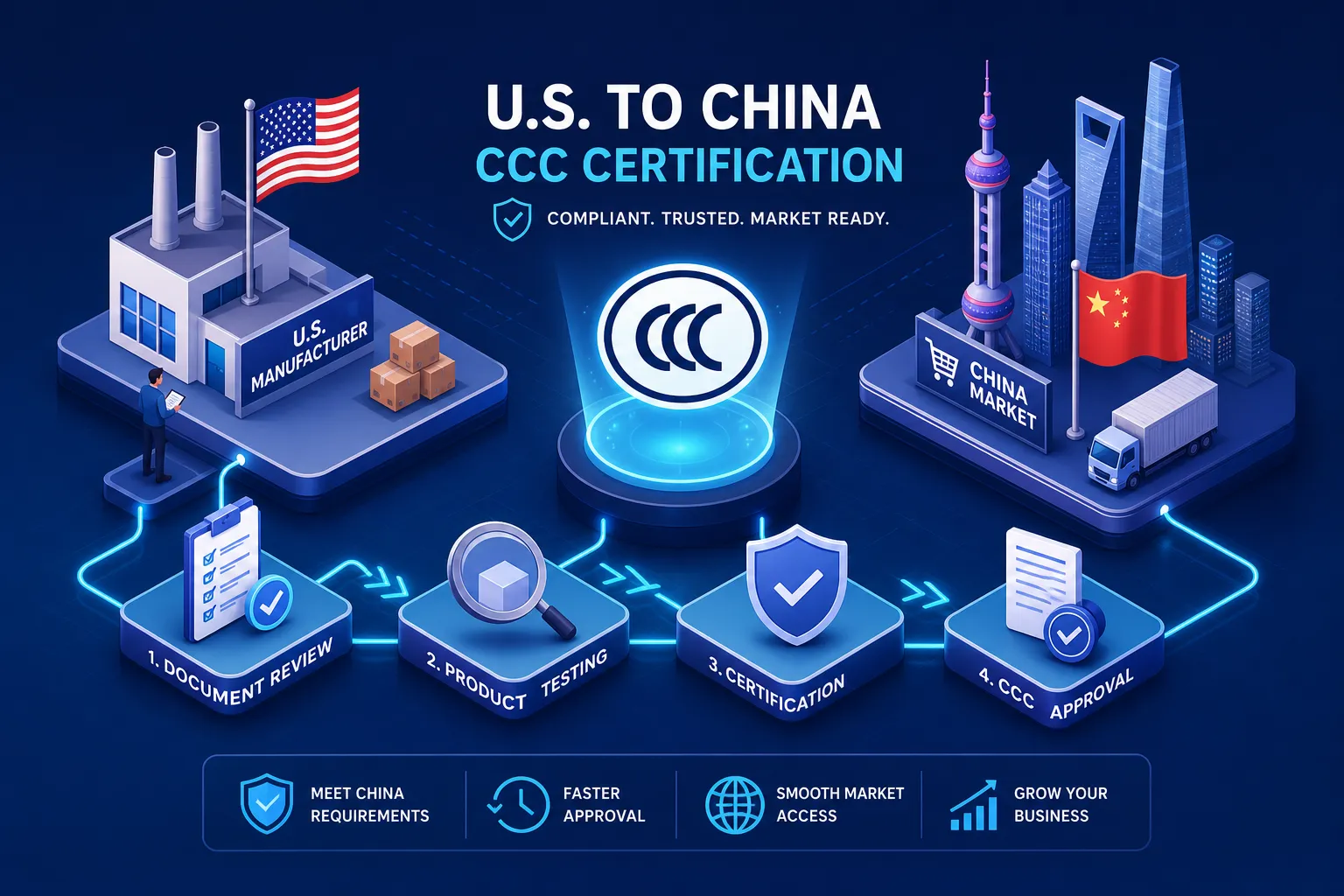
China Compulsory Certification (CCC) is a mandatory product certification required for many products sold, imported, or used in China. Before exporting, U.S. manufacturers must first determine whether their product falls within the CNCA's CCC catalogue. If it does, they must apply through a CNCA-designated certification body, complete product testing at an approved laboratory, pass a factory audit, and submit the required technical documentation. Once approved, the CCC certificate is generally valid for five years, with annual surveillance audits required to maintain certification.
The certification process typically takes 3–6 months and costs approximately RMB 20,000–80,000 (USD $2,800–$11,000+), depending on the product category and testing requirements. Companies with a well-documented Quality Management System (QMS), such as one based on ISO 9001, often complete the process more efficiently because many required quality records and procedures are already in place.
You've spent months building a relationship with a Chinese distributor. The product samples impressed them, pricing was agreed upon, and you were ready to receive your first purchase order. Then came the reply: "Please provide CCC certification before we can proceed." If you've never shipped products to China before, that three-letter acronym can feel like a wall you didn't see coming. If you're asking how to get China compulsory certification for your product as a U.S. manufacturer, you're in the right place, this guide covers eligibility, testing, factory audits, documentation, timeline, and costs so you know exactly what to expect before you spend a dollar.
The China Compulsory Certification system, known by its CCC mark, is China's mandatory product safety framework administered by the Certification and Accreditation Administration of China (CNCA). Certain product categories simply cannot be legally imported into, sold in, or used in China without it. This isn't optional compliance or a competitive differentiator. It's a legal market entry requirement, and regulators enforce it.
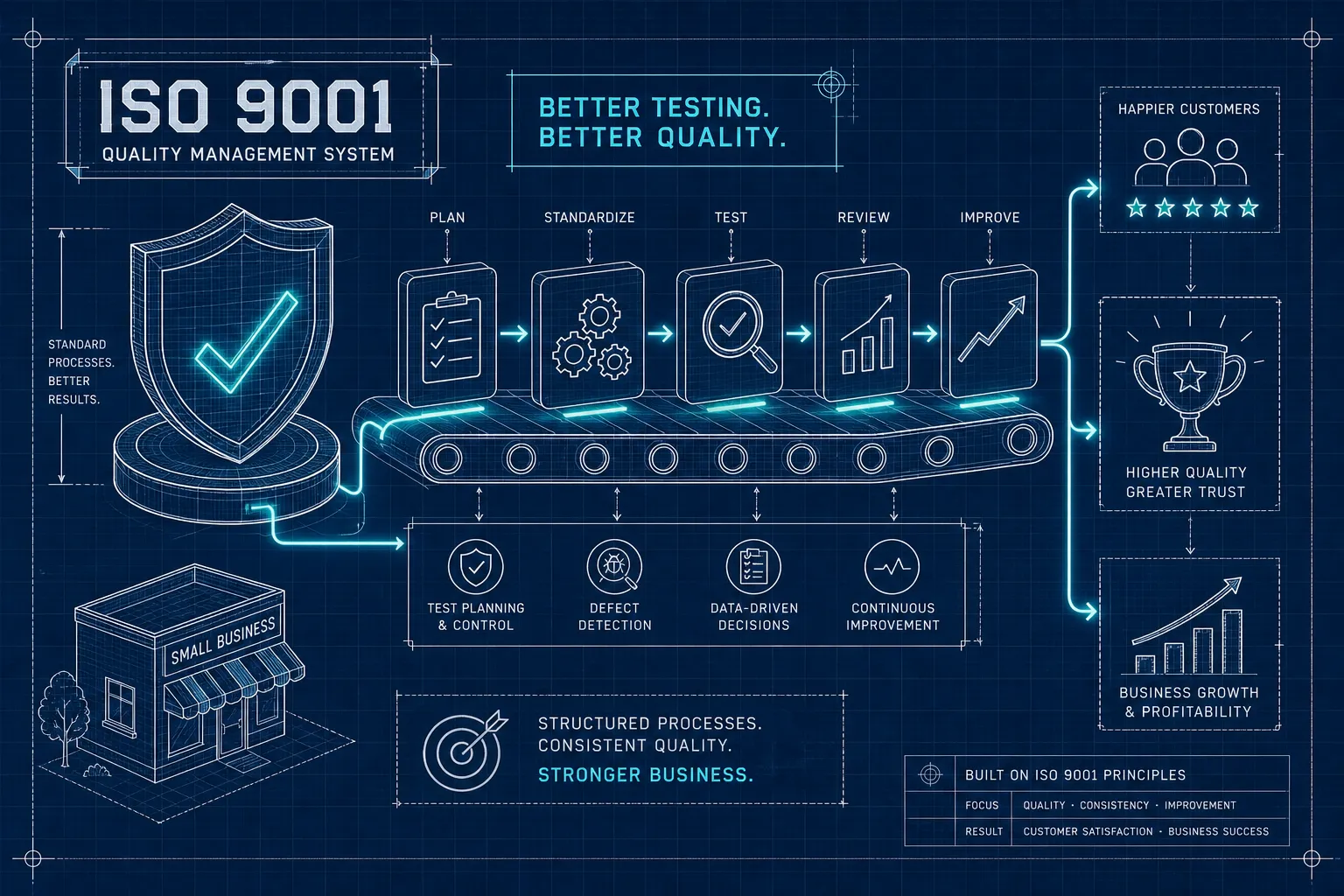
The process involves several moving parts: a formal application, type testing at a designated Chinese lab, an on-site factory audit at your U.S. facility, documentation in Simplified Chinese, and annual surveillance once the certificate is issued. Manufacturers who already operate with organized, audit-ready quality management systems tend to move through the CCC documentation phase faster. Both processes demand the same discipline around records, procedures, and traceability. This is the same foundation KSQA helps small businesses build through ISO 9001 certification programs. If you're starting from scratch, this guide will walk you through every step.
Does your product require the CCC mark?
The 17 product categories covered by the CNCA catalogue
The CNCA catalogue currently covers 17 major product categories. Confirming whether your product falls within one of them is the real first step, before you spend time or money on anything else. Those categories are:
- Wires and cables
- Circuit switches and protection or connection electrical devices
- Low-voltage electrical apparatus
- Small-power motors
- Power tools
- Welding machines
- Household and similar appliances
- Audio and video equipment
- Information technology equipment
- Telecommunication terminal equipment
- Lighting equipment
- Motor vehicles and safety-related vehicle components
- Agricultural machinery
- Fire protection equipment
- Security and burglar alarm products
- Decoration and renovation products
- Toys and children's products
Within those 17 categories, CNCA has issued implementation rules covering more than 100 specific product types. The catalogue is specific by design, so a product that is adjacent to a listed category may not qualify. The correct approach is to match your product's HS code to the CNCA catalogue entry. If there is no direct match, CCC does not apply to that product. Getting this confirmation right at the start prevents wasted application fees and avoids delays later in the process.
Products and situations that may be exempt
Several situations allow a product to enter China without CCC certification even when the product type is normally covered. Products imported solely for exhibition or display, small-quantity samples not intended for sale, and products used exclusively for R&D purposes are recognized exemptions under current CNCA rules. These exemptions are narrow and specific, not a workaround for routine commercial imports.
If your product simply does not appear in the CNCA catalogue, CCC does not apply. That said, other Chinese regulatory requirements may still be relevant. GB mandatory standards, customs documentation requirements, and sector-specific regulations can all affect market entry even without a CCC obligation. Confirming your product's status with a knowledgeable certification partner before assuming you're clear is time well spent.
How do U.S. manufacturers get China compulsory certification? The step-by-step process
Steps 1 and 2: Submitting the application and receiving your factory code
U.S. manufacturers apply through a CNCA-designated certification body (CB). CQC (China Quality Certification Center) handles the majority of product categories; CCAP (China Certification Centre for Automotive Products) covers automotive-related items. The application package includes a completed application form, a factory questionnaire, product documentation, and supporting technical materials. Once the CB reviews and accepts the application, it assigns a factory code to the manufacturing facility and confirms which GB test standards apply to the product. This step typically takes one to two weeks.
Steps 3 and 4: Type testing at a designated Chinese laboratory
After the application is accepted, product samples must be shipped to a CNCA-designated testing laboratory inside China. Testing against mandatory GB standards takes roughly 20 to 30 working days for standard products under normal conditions. Some product categories allow testing at designated foreign laboratories, but most still require a lab located in China, which means sample logistics and shipping time need to be factored into your planning from day one.
Failed tests are the most common source of timeline extension. If your product does not pass the initial type test, retesting is required, and that phase alone can stretch to two to three months. This is why pre-testing samples internally against the applicable GB standards before shipping to China is a smart investment for first-time applicants.
Steps 5 and 6: Factory inspection and certificate issuance
Once testing passes, CNCA auditors conduct an on-site factory inspection at your U.S. manufacturing facility. The audit is not a paperwork review. Inspectors evaluate production consistency, quality control processes, inspection and test equipment, traceability of critical components, how nonconforming products are handled, and whether the factory can reliably reproduce the type-tested product at scale. They often witness tests on-site and review quality records, corrective action history, and change management documentation.
Any nonconformities identified during the audit must be corrected and verified before the certificate is issued. After the review clears, the certificate is issued with a five-year validity period. Annual surveillance audits are required throughout that period, covered in the final section of this guide.
Documents every U.S. manufacturer must prepare before applying for China CCC certification
The core documentation checklist
Getting your documentation ready before submitting the application prevents delays at the review stage and improves audit readiness when the factory inspection arrives. The required package for most CCC applications includes:
- Completed CCC application form and factory questionnaire
- Detailed product description with technical specifications
- Production flow chart
- Quality manual (at minimum, table of contents and key procedures)
- Business license for both the applicant and the manufacturing facility
- Product schematics, photographs, and user documentation
- Chinese-language labels and nameplates
- Factory organization chart
- Any existing CB test reports or EMC test reports relevant to the product
The quality manual requirement is where many U.S. manufacturers get caught off guard. If your business doesn't have a documented quality management system, building one becomes a prerequisite project. This is exactly the kind of QMS infrastructure that KSQA builds with small manufacturers through ISO 9001 certification programs. A company that already has its processes documented, its records organized, and its quality procedures written will move through the CCC factory audit preparation phase significantly faster than one starting from scratch.
Chinese-language requirements and OEM/ODM agreements
All product labels and nameplates must be in Simplified Chinese before the application can advance. This is not a step you can defer. The CB will not accept an incomplete application, and translation errors on technical labels can trigger review delays that add weeks to the process. Working with a qualified technical translator familiar with Chinese regulatory labeling requirements is worth the cost.
If the CCC applicant is a third party rather than the actual manufacturer, such as a Chinese importer or authorized representative, an OEM/ODM agreement signed by all three parties (the applicant, the manufacturer, and the factory) is required. Understanding this relationship structure early and preparing the authorization documentation before submission prevents a common and avoidable source of application delay.
Realistic timeline and cost breakdown for 2026
Phase-by-phase timeline
For a standard product with no testing failures and no major audit nonconformities, the CCC certification process runs three to six months end to end. Breaking that down by phase: application review takes one to two weeks; type testing at a Chinese lab takes four to eight weeks under normal conditions, or up to twelve weeks if retesting is required; factory inspection scheduling and the on-site audit add one to three weeks; and final conformity review plus certificate issuance adds another two to four weeks.
Overseas manufacturers face additional time drivers that domestic Chinese companies don't: sample shipping to China, document translation, and coordinating audit scheduling across time zones. For a first-time U.S. applicant, planning for five months is a realistic and prudent baseline. Factor that timeline into your distributor or customer conversations early so no one is waiting on a purchase order that can't ship without a certificate in hand.
Typical fee ranges for 2026
The cost components for CCC certification break down across four main areas. Application and documentation fees run roughly RMB 500 to 1,300 (approximately $70 to $180 USD at current rates). Type testing fees vary significantly by product category and test scope, ranging from RMB 10,000 to over 50,000 (roughly $1,400 to $7,000+). Factory inspection is typically billed at RMB 2,000 to 2,500 per person-day for the CNCA audit team. Certificate registration and related charges are usually modest, around RMB 800, but ongoing maintenance fees apply during the five-year validity period.
All-in, most standard product categories land in the RMB 20,000 to 80,000 range (approximately $2,800 to $11,000 USD). Costs that are frequently underestimated include international sample shipping to China, professional translation services for technical labels and documentation, and retesting fees if the initial type test fails. Build these into your project budget from the start rather than treating them as surprises.
Choosing your certification body and authorized representative
CNCA-designated CBs: what you need to know
Not every certification body handles every product category, and choosing the wrong one wastes both time and application fees. CQC is the most broadly designated body and handles the majority of CCC product categories. CCAP is the body to use for automotive products and vehicle safety components. Other CNCA-designated bodies, including CSP for security products, CSCG for safety glass, and CEMC for electrical and EMC products, cover specific product groups within the catalogue.
The correct first step is to confirm your product's catalogue entry and then verify that your chosen CB's designated scope actually covers that entry. This is a simple confirmation that prevents a costly mismatch. Most CNCA-designated CBs publish their scope of designation, and any experienced certification partner can help you match your product to the right body before you submit anything.
What a good certification partner actually does for you
Most U.S. manufacturers benefit from working with an experienced certification consultant or agent who knows the CCC process from the inside. A capable partner coordinates sample shipping logistics, handles document translation, manages communication with the Chinese CB, schedules the factory audit, and tracks the application through each review stage. That coordination requires knowledge of CNCA procedures, relationships with designated labs, and the ability to respond quickly when the CB has questions.
The difference between a smooth four-month process and a stalled one often comes down to who is managing the coordination. That kind of structured, phase-mapped approach, where every document is prepared in advance and every audit is treated as a managed process rather than a surprise, is what separates clean certifications from costly delays. It's the same method KSQA applies to ISO 9001 programs. When evaluating a certification partner for your CCC project, ask about their specific experience with your product category, how they handle factory audit preparation, and whether they coordinate directly with the CNCA-designated CB throughout the process.
After the certificate: maintaining your CCC status
The CCC mark itself has specific display requirements. Standard approved sizes are 8 mm, 15 mm, 30 mm, 45 mm, and 60 mm. The mark must appear on an exposed location on the product body or nameplate. If the product's size or structure prevents direct marking, the mark must be applied to the smallest package and noted in the accompanying documents. Non-standard sizes are permitted only when linearly proportional to the standard design without distortion. The mark must remain clear, visible, and undeformed throughout the product's market life.
Annual surveillance audits are required every year during the five-year certificate period. CNCA auditors return to the manufacturing facility to verify that production quality has remained consistent with the original certification. Common triggers for corrective action requests during surveillance include changes to critical components or materials that were not reported to the CB, gaps in calibration or inspection records, and inconsistencies between the product on the floor and the approved type-tested sample. Manufacturers who treat quality documentation as an ongoing discipline rather than a one-time exercise consistently clear surveillance with minimal disruption.
Frequently asked questions: getting China compulsory certification as a U.S. manufacturer
How do I get China compulsory certification for my product as a U.S. manufacturer?
Start by confirming your product appears in the CNCA catalogue. If it does, select the correct CNCA-designated CB for your product category, prepare your documentation package (including a quality manual and Simplified Chinese labels), ship samples to a designated Chinese testing laboratory, pass the GB standard type tests, and clear the on-site factory audit at your U.S. facility. The certificate is then issued with a five-year validity. Plan for a five-month timeline and budget RMB 20,000 to 80,000 all-in for most standard categories.
Can a U.S. manufacturer apply for CCC certification directly?
Yes. U.S. manufacturers apply directly through a CNCA-designated CB. If a Chinese importer or authorized representative is listed as the applicant instead of the manufacturer, a three-party OEM/ODM agreement is required. Either structure is permitted under current CNCA rules.
What happens if my product fails type testing?
The product must be corrected to meet the applicable GB standard, and retesting is required. A failed test cycle can add two to three months to the overall timeline. Pre-testing against GB standards before shipping samples to China is the most reliable way to avoid this delay.
Start here
To get China compulsory certification for your product as a U.S. manufacturer, confirm your product's CNCA catalogue entry first. Then engage the correct CNCA-designated CB for your category, get your quality documentation in order before you apply, and plan for a five-month timeline. If your quality management system isn't ready for an audit, address that first. The manufacturers who approach CCC with the same organized, records-driven mindset they bring to ISO certification are the ones who get certified on the first run and maintain that certificate without complications year after year. Contact KSQA to get a preparation checklist specific to your product category.
Frequently Asked Questions (FAQs)
1. What is China Compulsory Certification (CCC)?
CCC is China's mandatory product certification system for specific product categories. Products covered by the CCC catalogue cannot legally be imported, sold, or used in China without obtaining CCC certification.
2. How do I know if my product requires CCC certification?
Check whether your product appears in the CNCA CCC product catalogue. The catalogue currently covers 17 major product categories, including electrical equipment, automotive products, household appliances, IT equipment, lighting, toys, and more.
3. Can a U.S. manufacturer apply for CCC certification?
Yes. U.S. manufacturers can apply directly through a CNCA-designated certification body (CB). Alternatively, a Chinese importer or authorized representative may apply on the manufacturer's behalf with the appropriate authorization agreements.
4. What is the CCC certification process?
The typical process includes:
- Confirm product eligibility
- Submit an application through a designated CB
- Complete product testing at an approved laboratory
- Undergo a factory inspection
- Address any nonconformities
- Receive the CCC certificate
- Complete annual surveillance audits
5. What documents are required for CCC certification?
Typical documentation includes:
- Application form
- Factory questionnaire
- Product specifications and drawings
- Production flowchart
- Quality manual or QMS documentation
- Business licenses
- Product labels in Simplified Chinese
- Product photographs and user manuals
- Test reports (if applicable)
6. Is ISO 9001 certification required for CCC certification?
No. ISO 9001 certification is not mandatory, but having a documented Quality Management System makes factory audits, documentation preparation, and ongoing compliance significantly easier.
7. How long does CCC certification take?
Most first-time applications require approximately 3–6 months, although testing failures, document revisions, or audit findings can extend the timeline.
8. How much does CCC certification cost?
For most products, total certification costs—including application, testing, factory inspection, and certification fees—typically range from RMB 20,000 to 80,000 (approximately USD $2,800–$11,000+), excluding shipping, translation, and possible retesting expenses.
9. What happens if my product fails CCC testing?
The product must be modified to meet the applicable Chinese GB standards before undergoing retesting. This can extend the certification process by several weeks or months.
10. How do I maintain CCC certification?
CCC certificates generally remain valid for five years, provided the manufacturer successfully completes annual surveillance audits, maintains consistent production quality, reports significant product changes when required, and continues to comply with applicable certification requirements.
.jpg)

.webp)
.jpg)
