
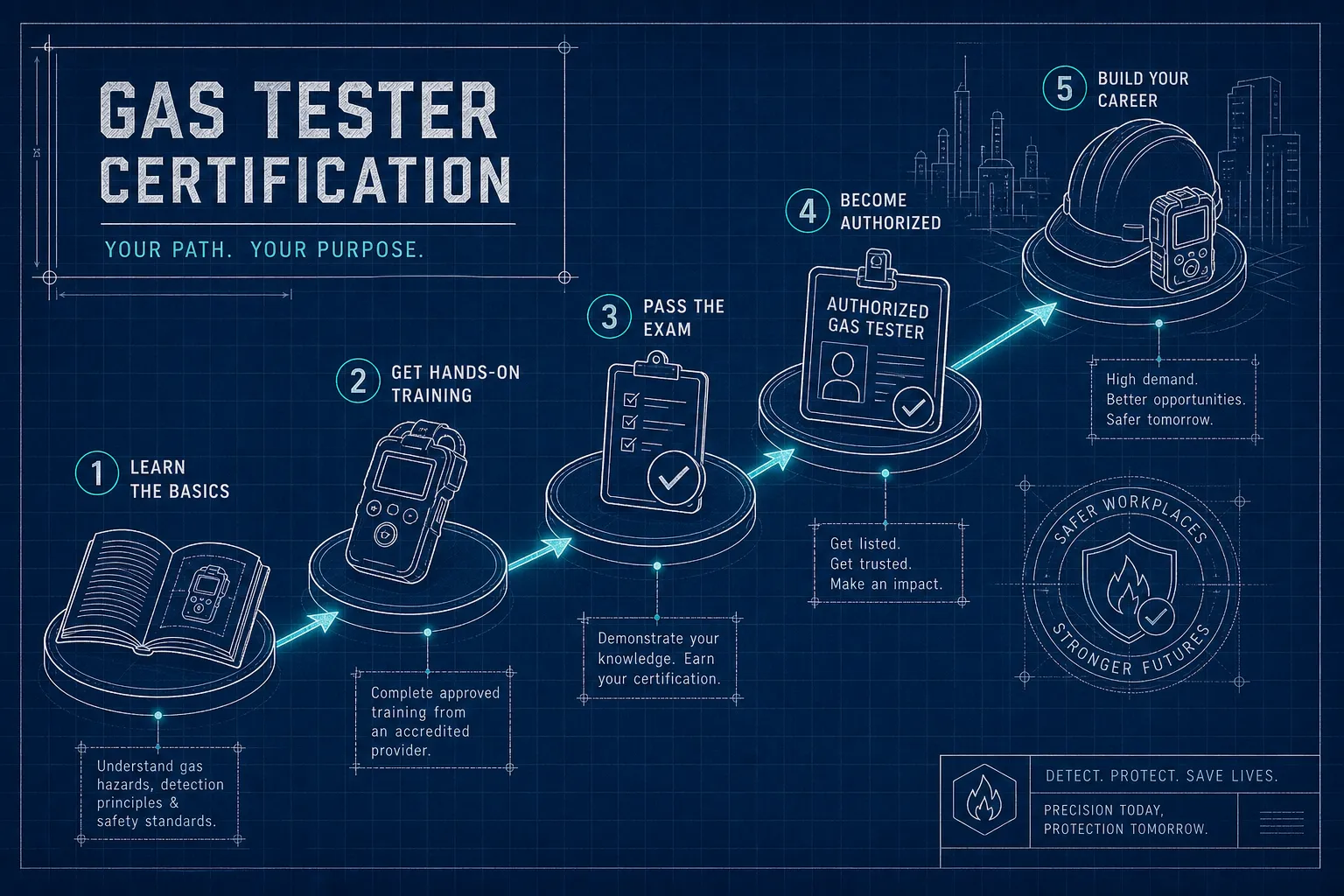
An Authorized Gas Tester (AGT) is the trained and employer-authorized individual responsible for testing atmospheric conditions before and during confined space entry or hot work. In the U.S., there is no single national AGT license. Instead, qualification typically involves completing recognized gas testing training, demonstrating competency with gas detection equipment, and receiving formal employer authorization.
The primary regulatory requirement is OSHA 29 CFR 1910.146 for permit-required confined spaces, supported by standards such as OSHA 1926 Subpart AA, HAZWOPER (1910.120), and Respiratory Protection (1910.134). Industry best practices also reference ANSI/ASSP Z117.1 and NFPA 350.
To become an AGT, complete a recognized training program, learn to use and maintain calibrated gas detectors, understand confined space hazards, document testing correctly, and keep your authorization current through refresher training and employer records.
Every year, workers die in confined space incidents that a qualified gas tester could have prevented. If you've been asking how do I become an authorized gas tester and what standards apply in the U.S., this guide gives you the direct answer: it means meeting a specific set of regulatory and employer requirements, not just attending a one-day class. Atmospheric hazards don't announce themselves, and the person responsible for detecting them has to know exactly what they're doing.
This guide walks you through the complete path to qualifying as an Authorized Gas Tester (AGT) in the U.S.: what the role covers, which OSHA regulations govern it, what a recognized training course looks like, how equipment responsibilities work, and how to keep your authorization current. By the end, you'll have a clear, actionable step-by-step plan for the entire process.
What an authorized gas tester actually does
The AGT is the designated person responsible for testing atmospheric conditions before and during confined space entry or hot work operations. That responsibility centers on three primary hazard categories: oxygen deficiency or enrichment, flammable or explosive gases, and toxic gas concentrations. This is a designated competency role, earned through training and employer authorization, not a title someone receives for seniority.
The role appears across a wide range of industries: oil and gas, construction, shipbuilding, utilities, wastewater, and petrochemical operations, as well as any industry involving permit-required confined spaces. You may see it listed under different names, including Competent Person for Atmospheric Testing, Gas Tester, or Confined Space Monitor. The title changes, but the regulatory weight stays the same.
Not every confined space worker qualifies as an AGT. The AGT is specifically trained and employer-authorized to conduct testing, interpret readings, and make the go/no-go call on atmospheric safety. OSHA 29 CFR 1910.146 is built around that distinction. Without formal training and a documented employer designation, you're a worker with a detector, not a legally recognized tester.
The U.S. regulations every authorized gas tester must know
OSHA 29 CFR 1910.146 is the primary regulation governing permit-required confined spaces and the anchor for any gas testing program. It requires atmospheric testing before entry to verify acceptable conditions, ongoing monitoring during entry, and re-testing after a significant work break or change in conditions. Appendix B of 1910.146 specifically explains the purpose and method of atmospheric testing, and OSHA guidance confirms that testing conducted in accordance with Appendix B satisfies the standard.
The required testing sequence matters under this rule: oxygen first, then flammable or combustible gases and vapors, then toxic gases and vapors. Testing must be conducted using a calibrated direct-reading instrument, and acceptable oxygen levels are defined as 19.5% to 23.5% by volume. These are enforceable requirements, and OSHA inspectors verify compliance with each one.
Several supporting OSHA standards intersect with gas testing work:
- 29 CFR 1926 Subpart AA: Construction confined spaces, with parallel testing and monitoring obligations to the general industry rule.
- 29 CFR 1910.120 (HAZWOPER): Hazardous waste and emergency response atmospheric monitoring requirements.
- 29 CFR 1910.134: Respiratory protection, where gas test results directly drive respirator selection decisions.
OSHA sets the regulatory floor. Industry best practice often goes further, and employers regularly reference ANSI/ASSP Z117.1 as the leading consensus standard for confined space safety. Z117.1 requires continuous monitoring when an atmospheric hazard potential exists, specifically when conditions can change due to broken pipes, disturbed materials, or adjacent work. NFPA 350 reinforces that approach, favoring continuous air monitoring when conditions cannot be reliably controlled. Both standards are voluntary, but they're widely adopted by employers and routinely referenced during audits and insurance reviews.
How do I become an authorized gas tester? A step-by-step path
There is no single national AGT license in the U.S. What you pursue depends on your industry and what your employer or job posting specifically requires. The three main recognized pathways are OSHA-aligned gas detection and atmospheric testing courses, OPITO Authorized Gas Tester certification (widely recognized in oil and gas), and employer-specific Gas Tester Competent Person programs. If a job posting mentions OPITO, pursue the OPITO course. If it emphasizes U.S. regulatory compliance, choose an OSHA-aligned atmospheric testing course with confined space coverage.
Most qualifying courses run one to two days, combining 8 to 16 hours of classroom instruction with hands-on practical sessions. When evaluating a course, look for OSHA regulatory coverage, confined space and hot work scenarios, live equipment training, and a formal assessment component. OPITO-certified courses issue a certificate typically valid for two to three years, and some providers issue certificates of attendance with a stated two-year validity. Choose a course based on whether your employer and your industry will accept it, not solely on price.
Employer authorization is the operative legal designation. In most U.S. industrial settings, the employer formally designates an AGT based on completed training and demonstrated competency. A third-party certificate supports that decision but does not replace it. The employer should maintain the original training certificate, an appointment or designation record, and a refresher log. One important exception: California has a formal Gas Tester Certification issued by the Division of Occupational Safety and Health for underground mines and tunnels, which is a state-issued credential valid for five years and requires both written and oral requalification exams at renewal.
What AGT training covers and how you're assessed
A well-structured AGT course covers these core topics:
- The AGT's role and legal responsibilities
- Properties and behavior of oxygen, flammable, and toxic gases
- OSHA regulatory requirements and relevant consensus standards
- Atmospheric hazard thresholds and action levels
- Proper use and limitations of gas detection equipment
- PPE and respiratory protection decisions
- Permit-to-work documentation and recordkeeping
This isn't a surface-level overview. Courses built to OPITO's Level 1 standard organize this content across four mandatory units covering the AGT role, flammable gas testing for hot work, confined space testing, and gas monitoring.
The practical component is where you prove you can do the work. Quality programs include live operation of multi-gas detectors, confined-space mock scenarios, interpreting readings against safe entry limits, and completing sample permit documentation. The best programs run a multifaceted scenario where you test, interpret, document, and make an entry recommendation under evaluation conditions. That scenario work is what separates a real qualification from a slide-deck certificate.
Assessment typically requires both a written knowledge test and a practical competency demonstration. The written pass mark is commonly 80%, and the practical component is evaluated as passed or not passed rather than scored numerically. Some OPITO-aligned programs assess candidates against a defined permit-to-work scenario. Both components must be passed to earn the certificate. If you don't pass the practical, you don't get the cert regardless of your written score.
Equipment duties: gas detectors, bump tests, and documentation
An AGT must be fully competent with the instruments they use. Standard equipment includes multi-gas portable detectors measuring oxygen, LEL (lower explosive limit), CO, and H₂S as a minimum, along with single-gas monitors for specific hazards and fixed monitoring systems in some settings. Knowing how to operate, troubleshoot, and accurately interpret readings from these instruments is a core AGT competency.
Bump testing before every use is the non-negotiable baseline. A bump test is a qualitative function check confirming that sensors respond and alarms activate. Under U.S. best practices and OSHA guidance, portable detectors should be bump tested before each use, and at minimum before each day's use. Full calibration follows the manufacturer's recommended intervals, typically every 30 to 180 days depending on the instrument and operating conditions, and calibration gases should be traceable to NIST reference standards. Failing to bump test before entry is one of the most common compliance gaps found during audits, and one of the easiest to fix.
If a detector fails a bump test, it must be fully calibrated before use. If it fails full calibration, it comes out of service. Record every bump test and calibration event in the instrument log, including the test date, results, and calibration due date. That log is what an OSHA inspector or insurance auditor will request when verifying that your program is operational, not just documented on paper.
An AGT's job doesn't end after the initial reading. Gas test results must be documented on the permit-to-work form. Re-testing is required when the permit is revalidated, after a major work break, when workers re-enter, and any time site conditions change. Good recordkeeping is both a regulatory requirement and a practical safety control, it creates an auditable record of every decision made before and during entry.
Keeping your authorization current: renewal, records, and the bigger compliance picture
Refresher timing varies depending on the governing standard and the issuing body. OPITO certificates typically run two to three years. Some employer programs set annual requalification. California's formal Gas Tester Certification for underground mines and tunnels requires a full written and oral exam every five years. Know which interval applies to your credential and mark the renewal date well in advance. Letting a certificate lapse creates gaps in your employer's authorization records that are difficult to reconcile after the fact.
Employers need to maintain a complete file for each authorized gas tester. That file should include: the original training certificate, the employer designation or appointment letter, calibration and bump test logs for assigned instruments, refresher and requalification records, and any incident or near-miss documentation tied to atmospheric testing. This is the documentation set an OSHA inspector or contracting officer will request when verifying your program's validity.
Many companies that build a disciplined AGT compliance program find that the same rigor extends naturally to their broader quality management practices. When clients, prime contractors, or RFPs require evidence of a certified quality management system alongside individual safety qualifications, the gap becomes visible quickly. Pairing an authorized gas tester program with an ISO 9001-certified QMS signals to customers and prime contractors that both quality and safety are managed systematically. For small businesses taking that next step, KSQA offers a structured path that makes ISO 9001 certification practical and affordable, so you're building a real compliance framework rather than starting from scratch.
The road to authorization is clear. Now walk it.
Becoming an authorized gas tester in the U.S. follows a clear sequence: understand the role and its responsibilities, know the regulations anchored in OSHA 1910.146, complete a recognized training course with a practical assessment component, earn employer authorization with proper documentation, stay disciplined with equipment checks and recordkeeping, and refresh your credentials on schedule. None of those steps are optional, and none of them are particularly complicated once you know what they require.
The standards exist because atmospheric hazards have killed workers in spaces that looked safe from the outside. Knowing the regulations, operating your equipment correctly, and maintaining complete records makes you a more effective AGT and a more valuable member of any safety-conscious team. Authorized gas tester requirements in the U.S. are demanding by design, competency and documentation together are what clients, prime contractors, and regulatory agencies verify.
If you've worked through this guide asking how do I become an authorized gas tester and what standards apply in the U.S., you now have the full picture. When your organization is ready to extend that compliance culture into a certified quality management system, KSQA is built to help small businesses make that move with confidence. Reach out to explore how KSQA's Certification Road Map can get your business ISO 9001 certified without the complexity that holds most companies back.
Frequently Asked Questions
How do I become an authorized gas tester in the U.S.?
Complete a recognized gas testing or confined space training course, demonstrate competency with gas detection equipment, and receive formal authorization from your employer. Most employers require both practical skills and documented training before assigning AGT responsibilities.
Is there a national Authorized Gas Tester certification?
No. The United States does not have a single national AGT license. Most workers qualify through employer authorization after completing OSHA-aligned or industry-recognized training, while some industries use programs such as OPITO Authorized Gas Tester certification.
Which OSHA standard applies to authorized gas testers?
The primary regulation is OSHA 29 CFR 1910.146 for permit-required confined spaces. Other relevant standards include 29 CFR 1926 Subpart AA, 29 CFR 1910.120 (HAZWOPER), and 29 CFR 1910.134 for respiratory protection.
What gases must an AGT test for?
An Authorized Gas Tester typically checks for:
- Oxygen deficiency or enrichment
- Flammable or combustible gases (LEL)
- Toxic gases such as carbon monoxide (CO) and hydrogen sulfide (H₂S)
Additional gases may be monitored depending on workplace hazards.
How long does AGT training take?
Most Authorized Gas Tester courses last one to two days (8–16 hours) and combine classroom instruction with hands-on practical exercises and competency assessments.
How often should a gas detector be bump tested?
Industry best practice recommends performing a bump test before each use, or at minimum before each day's operation, to verify that sensors and alarms function correctly.
How often should gas detectors be calibrated?
Calibration should follow the manufacturer's recommendations, typically every 30 to 180 days, or immediately if the detector fails a bump test.
How long is Authorized Gas Tester certification valid?
Validity depends on the training provider or employer. Many industry certifications remain valid for two to three years, while employers may require annual refresher training. Certain state-specific certifications, such as California's underground mine and tunnel Gas Tester certification, have different renewal periods.
What records should employers maintain for authorized gas testers?
Employers should keep:
- Training certificates
- Employer authorization records
- Bump test and calibration logs
- Refresher training records
- Permit-to-work documentation
- Incident and corrective action records
Maintaining these records helps demonstrate compliance during OSHA inspections and safety audits.
Why is Authorized Gas Tester training important?
Proper atmospheric testing prevents workers from entering confined spaces with dangerous oxygen levels, flammable atmospheres, or toxic gases. Competent testing, accurate documentation, and regular equipment checks significantly reduce the risk of serious injuries and fatalities.


.jpg)

.png)
.jpg)